By
H. D. P. Envall and Thomas S. Wilkins
2024
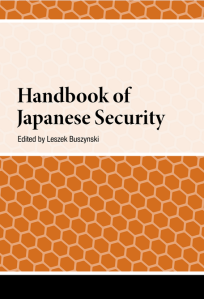
Authors: HDP Envall and Thomas S. Wilkins
Title: “Japan and Australia: Forging an Indo-Pacific Partnership”
Publication year: 2024
Publication type: book chapter
https://www.aup.nl/en/book/9789048564217/handbook-of-japanese-security
Envall, H.D.P. and Wilkins, Thomas S. (2024) “Japan and Australia: Forging an Indo-Pacific Partnership,” in Leszek Buszynski (ed.) Handbook of Japanese Security, Tokyo: MHM Limited, Amsterdam: Amsterdam University Press, pp. 384–99.
Defined as a “special strategic partnership,” the Japan-Australia relationship is qualitatively distinct from many of Tokyo’s other bilateral relationships. In particular, it exhibits features that mark it out as a security alignment and perhaps even a “quasi-alliance,” in that it is sustained by the two countries’ relationships with the United States. This chapter argues that the Japan-Australia partnership has developed as a multi-faceted alignment mechanism founded upon shared interests and values. It encompasses a full spectrum of functions and, moreover, represents an attempt by the two countries to promote an “Indo-Pacific” vision, which embodies their shared worldview and common agenda for action.
Introduction
The connection between Japan and Australia is qualitatively distinct from many of Tokyo’s other bilateral relationships. Self-defined as a “special strategic partnership,” it enjoys a high priority in Japanese and Australian diplomacy, as well as exhibiting a number of features that mark it out as a security alignment. This not only places it in a different category from more routine bilateral relationships but requires different tools for analysis and conceptualization. In its shared goal of forging a free and open Indo-Pacific and its emphasis on ever closer collaboration on capabilities rather the mutual security commitments, the Japan-Australia relationship represents a strategic partnership as security practice but one that is akin to a “quasi-alliance” sustained by the two countries’ relationships with the United States. In this chapter, we argue that the partnership has developed as a multi-faceted alignment mechanism founded upon shared interest and values. This now encompasses a full spectrum of functions, ranging from joint diplomacy, through security/defense and economics, to multilateralism/minilateralism. Perhaps more significant, however, is the attempt by the two countries to promote an “Indo-Pacific” vision to create a common meaning and purpose for their relationship in which both are embedded and reflective of their shared practices.
Security Cooperation
Security cooperation between Japan and Australia has become increasingly close since the mid-2000s. What began as a basic “strategic partnership” in 2007 has become an important component of the security architecture in the Asia-Pacific region.1 The bilateral relationship has not been without its ambiguities or complications. The two countries share a difficult history due to the Second World War and stand far apart on some notable issues, such as international whaling.2 They can also still be prone to misreading each other’s diplomatic signaling, as exemplified by the drama surrounding Japan’s ultimately unsuccessful tender for Australia’s future submarine contract in 2016.3 Yet the overall trajectory of relations has been unmistakably upward. In late 2013, then-Australian Prime Minister Tony Abbott described Japan as “Australia’s closest friend in Asia.”4 In July 2014, Japanese Prime Minister Abe Shinzō addressed the Australian parliament and described Australia as an “indispensable partner.”5 The relationship has even been described by some in Japan and Australia as a “quasi-alliance” (jun dōmei).6
The partnership also represents an emerging trend in the contested strategic order in the Indo-Pacific—an example of a new form of security alignment, the “strategic partnership.”7 Such partnerships can be found around the globe.8 They are also a central characteristic of Asia’s evolving security architecture.9 In Asia, they have been deployed to achieve multiple strategic objectives, from managing relations between rivals to deepening already close relationships between friends. For the United States, with its “hub and spokes” system of alliances in Asia, they have become a means of developing intra-spoke relations between American partners.10 As one of the closest and most developed examples of this trend, the Japan-Australia partnership raises some important questions regarding this new form of security alignment. What kind of partnership have these two countries built since 2007? Why have they strengthened their relationship so significantly? And how is their special partnership likely to evolve in future? Such questions hold important implications for scholars’ understanding of the shifting patterns of international relationships, alignments and institutions of the Indo-Pacific at a time when the regional order is being vigorously contested. The Japan-Australia relationship, therefore, represents the archetypal strategic partnership as “security practice,” tying together shared functions, meaning and purpose.11 Moreover, the partnership has been further sustained by the two countries’ respective alliances with the United States, and which provides an underlying framework allowing the two countries to develop their relationship in terms of capabilities rather than commitments and to engage in cooperation that is not merely “threat-driven” but also “goal-driven.”12 In this sense, we suggest, the Japan-Australia partnership is not dissimilar to Victor Cha’s idea of a quasi-alliance, that is, the “relationship between two states that are un-allied but share a third great power patron as a common ally.”13 It is within this wider framework that the partnership is most likely to grow in future.
Asian alignments
How states cooperate in the pursuit of security is a fundamental question for international relations. A basic view is that states form alliances or pursue cooperative security relationships of various kinds to increase their security in the anarchical international environment. Such cooperative security relationships thus constitute the main external means for states to increase their security beyond their own internal efforts.14 This is especially true in Asia, as China has risen, and the US has (so far) sought to maintain its own preeminent position. The way that states forge alliances—or align together by other means “permeates all aspects of IR” and has both theoretical and empirical relevance.15 Yet the concept of alliance itself is not well suited to the shifting pattern of such relationships in Asia over the past decade. States no longer appear to be forming new alliances, in the sense defined by Glenn Snyder—as “formal associations of states for the use (or non-use) of military force, in specified circumstances, against states outside their own membership.”16 Whereas alliances are tight binding commitments specifically pivoting on a mutual obligation in the use force, other forms of cooperative security relations have emerged in Asia that do not necessarily entail such definitive obligations. These might be better characterized as alignments, which represent something of an “umbrella concept” for describing different forms of security cooperation in the region.17 As with alliances, other forms of alignment are also concerned with the expectations of states regarding support they may receive from others. Yet, as the “broader and more fundamental term,” they encompass multiple forms of cooperation, including alliances themselves, but also: coalitions, security communities, ententes, non-aggression pacts, quasi-alliances, concerts and strategic partnerships.18 Asia encompasses the full panoply of alignments. Briefly noted, the most significant alliances in the region include those led by the US, such as those with Japan and Australia. Contrariwise, the Association of Southeast Asian Nations (ASEAN) styles itself as a “security community.”19
Where do strategic partnerships fit into this pattern of alignments? Strategic partnerships are sometimes understood in the literature as new types of security practice, meaning “socially meaningful patterns of action” repeated over multiple iterations based on shared knowledge relating to the function, meaning and, especially, purpose of such practice.20 Such partnerships can be characterized as a form of “structured collaboration between states (or other ‘actors’) to take joint advantage of economic opportunities, or to respond to security challenges more effectively than could be achieved in isolation.”21 Their principal features are an emphasis on “system principles,” such as order-building, and their preference for “goal-driven rather than threat-driven arrangements.” While strategic partners may identify “joint security issues-areas” they tend not to identify external states as defined enemies.22 As Vidya Nadkarni argues, strategic partnerships are “neither explicitly targeted at a specific country nor contain binding defense commitments.”23
There are multiple strategic partnerships in Asia, including partnerships between the US and India, Australia and India, Japan and ASEAN, as well as many involving China (including with Russia).24 This rise of strategic partnerships in the region follows the growing need for more informal and flexible approaches for actors to hedge between the great powers; China and the United States.25 Asia’s partnerships come in a broad range of shapes and sizes. Some are based on only the barest of documentation, with few if any substantive interactions. Others, by comparison, entail an extensive array of cooperative endeavors and engagements. Likewise, these partnerships evolve in quite different ways. Some fail to develop in any meaningful fashion or quickly become moribund, while other partnerships grow ever closer. The 2014 China-Australia “comprehensive strategic partnership” is a good example of the former.26 1t failed to develop any substantive engagements and then broke down entirely as Australia criticized China’s response to the COVID-19 pandemic and China responded by sanctioning Australia economically.27 By comparison, the Japan-Australia partnership probably counts as exemplary of the latter.28
What drives the growth or decline of such partnerships? Where there is an absence of shared practices around functions, meaning and purpose, it seems reasonable to expect that such partnerships may struggle to move beyond a rhetorical starting point or even disintegrate entirely, as with the China-Australia partnership. The emergence of a sudden security threat, on the other hand, might push a strategic partnership into becoming a fully-fledged alliance, to redress the lack of military-defense commitments in such partnership. Such a situation appears to have occurred in the case of Sweden and Finland seeking to join the North Atlantic Treaty Organization in response to Russia’s invasion of Ukraine in 2022.29 Instead, a strategic partnership is likely to strengthen where there is a symbiotic relationship between the functional needs of the partners and the potential for a shared meaning and purpose that remains within the narrow band between hollow engagement on the one hand and mutual military obligations on the other.
A special strategic partnership
From the end of the Second World War until 2007, Australia and Japan developed their relationship slowly and steadily. They did so by deepening their interactions across a range of areas, from trade to cultural and political engagement. Notwithstanding lingering animosity over the Second World War, principally from the Australian side, only five years after the resumption of normal diplomatic relations the two sides were able to sign, in July 1957, an Agreement on Commerce, which provided a basis for future trading relations between the two countries.30 Diplomatic relations were gradually upgraded in subsequent years, while bilateral trade boomed.31 Diplomatic cooperation, including on security issues, increased in the 1970s and, in 1976, the two sides signed the Basic Treaty of Friendship and Cooperation or Nippon-Australia Relations Agreement (NARA). NARA provided reassurance to both with respect to their mutual political and economic interests and especially in terms of investment relations.32 By 1995, when the two countries signed the Joint Declaration on the Australia-Japan Partnership, and so promoted the relationship as “an enduring and steadfast partnership,” they had established a broad, if somewhat low-key, relationship covering trade and investment, political interests, peacekeeping cooperation, as well as cultural, educational and people-to-people links.33 Yet the 2007 Japan-Australia Joint Declaration on Security Cooperation (JDSC) took the relationship well beyond its previous settings. The JDSC made the relationship a much more conspicuous part of the region’s strategic landscape and placed it in a distinct and elevated category-a true strategic partnership. It represented the first time Japan had entered into an international security agreement since its treaties with the US, and it affirmed that the two countries shared a strategic partnership “based on democratic values, a commitment to human rights, freedom and the rule of law, as well as shared security interests, mutual respect, trust and deep friendship.”34 The central aim of the agreement was to establish a bilateral framework: first, to enable more effective cooperation across a range of practical security areas, such as counter-terrorism and humanitarian relief operations; and second, to allow for common strategic approaches, especially via the mechanisms of annual foreign and defense ministers meetings (the “2 + 2 meetings”).35 Nine 2+2 Foreign and Defense Ministerial Consultations have been held since 2007, with the latest taking place virtually in June 2021.36
In subsequent years, the two sides have further increased the level of their cooperation. In particular, they have cooperated on security issues across a range of areas including joint exercises by all services, regular staff exchanges, humanitarian assistance and disaster relief (HADR) operations, and peacekeeping.37 Australian forces contributed in this area during the 3.11 “Triple Disaster” in Japan through Operation Pacific Assist. Japan was later able to reciprocate with HADR during the bush fires in Australia in 2019–2020.38 The Acquisition and Cross-Servicing Agreement (ACSA) and Information Security Agreement (ISA), signed by the two sides in 2010 and 2012 respectively, provide mechanisms for cooperation across a range of areas, such as those noted above, and for the sharing of intelligence assessments.39 In 2014, the two countries elevated the partnership to “special” status and also signed an Economic Partnership Agreement (EPA) to develop bilateral trade and a Defense Equipment and Technology Agreement to facilitate technology transfers.40 After long negotiations, a Reciprocal Access Agreement (RAA), which would allow their military personnel to cooperate more closely, was finally signed in 2022.41
The COVID-19 pandemic has galvanized joint efforts to collaborate on a range of challenges. First, it has prompted Japan and Australia to coordinate their efforts at mitigating the impacts of the pandemic and thus to boost access not only to vaccines but also to therapeutics and diagnostics.42 Joint collaboration between leading national scientific institutes such as Australia’s CSIRO (Commonwealth Scientific and Industrial Research Organisation) and Japan’s Riken (Institute of Physical and Chemical Research) has been enabled through the Japan-Australia Joint Science and Technology Cooperation Committee.43 Second, the COVID-19 crisis has also highlighted the importance of economic security issues more generally for the strategic partners. At the 2020 Japan-Australia leaders’ summit, the two countries “confirmed that a key element of bilateral security cooperation is to promote coordination in the area of economic security.”44 With COVID-19, the two countries have become concerned about maintaining secure supply-chains for critical goods and services, as well as the potential for major trading partners to engage in economic coercion.
An “Indo-Pacific” partnership
The attachment on the part of Japan and Australia to the established regional order has served to mold and to galvanize the partnership. This attachment, however, has not been to ”Asia” or to the ”Asia-Pacific”—the dominant descriptors for the region over previous decades—but to a new or, more accurately, revitalized term: the “Indo-Pacific.”45 Japan and Australia have mutually embraced the “Indo-Pacific” concept to frame their joint (and individual) foreign and security priorities. Advocacy groups in both countries have led efforts to transform the geopolitical framework through which Japanese and Australian policymakers view the region- from the previous Asia-Pacific lens to the new Indo-Pacific vision.46 Former Japanese Prime Minister Abe Shinzō was instrumental in reshaping the discourse through his 2007 invocation of the “confluence of two oceans” (futatsu no umi no majiwari), the Indian and the Pacific.47 By 2019, former Australian Prime Minister Scott Morrison was telling Australian audiences that the “Indo-Pacific is where we live.”48
As an explanatory concept, the Indo-Pacific term remains keenly contested.49 As a normative term—a proposal for how the region should be ordered—it flows from the two countries’ motivation to drive the regionalization of Asia.50 Both Japan and Australia have been active participants in this endeavor, their aim being to define the region as widely and inclusively as possible. They have done this not only to justify their own participation in the region but also to ensure that allies and partners such as the US and India also remain centrally engaged. This approach notably contrasts with that of Beijing (among others), which has sought to center the region around the narrower more exclusive form of “East Asia.”51 This impetus is reflected in their joint efforts at regional institution-building and participation, going back to the Asia-Pacific Economic Cooperation (APEC) forum, but presently evident in the Comprehensive and Progressive Agreement for Trans-Pacific Partnership (CPTPP), which the two partners went ahead to champion when the US pulled out of the original Trans-Pacific Partnership (TPP) in 2016.52
The Indo-Pacific construct also comports well with the two countries’ shared insular geography, positioned off the northeast (Japan) and southeast (Australia) of the Asian continent respectively. Japan is a self-identified “maritime nation,” and while Australia has been a little slower to embrace its maritime destiny—due to the scale of the island-continent it inhabits—this is now fully reflected through the Indo-Pacific concept.53 Lastly, while the prior “Asia-Pacific” regional construct evinced strong economic and trade overtones, the Indo-Pacific combines this with an emphasis on security, as both countries perceive mounting challenges to the regional order. These factors combined inform the ways in which Japan and Australia have sought to operationalize their partnership as an Indo-Pacific alignment. Nowhere are the ramifications of the shared Indo-Pacific mindset more evident than in the partners joint adherence to the “Free and Open Indo-Pacific” (FOIP) vision. Originally conceived by Tokyo in 2016, the term was then adopted and incorporated by the US into its Indo-Pacific Strategy in 2019.54 Australia, with some semantic equivocation along the way, has effectively acceded to the FOIP nomenclature. The FOIP now forms the de facto “mission statement” of the partnership and is designed to superintend combined regional policy, with the partners declaring their “determination to deepen cooperation to promote a free, open, inclusive and prosperous Indo-Pacific region.”55
The original framework of Japan’s FOIP is aimed at advancing three “pillars”: rule of law, economic prosperity and peace and stability.56 This is a sufficiently expansive remit to accommodate a range of joint activities within the strategic partnership, but all of these are essentially aimed at a shared desire to maintain a so-called rules-based order.57 Such an order, from the perspective of Tokyo and Canberra, is one in which the values of openness, transparency, free and fair trade and international laws and norms are upheld, and economic coercion, efforts to change the status quo (in the maritime/territorial sphere) and unilateral actions are impermissible. Lacking the national strength or inclination to assert their interests through coercion or force, neither country can accede to a regional order in which “might makes right.” Unspoken in this assertion is their shared strategic interest in underwriting the remnants of the liberal international order—a related but distinct notion—based upon American global and regional primacy.58 The goal of keeping Washington engaged represents a more realpolitik motivation for FOIP within its broader ideological claims. Thus, an ongoing US presence is inexorably linked to this new idea of region. Indeed, the wider aims and activities of the strategic partnership ties in with many aspects of the US Indo-Pacific Strategy, demonstrating how the partnership intersects with their mutual alliance relationships and the hub-and-spoke system as a whole.59 Despite the damage to American credibility caused by the Trump administration, both countries have expressed confidence that the US will ensure it retains its preeminent standing in the Indo-Pacific. As former Minister for Foreign Affairs Marise Payne noted, “a strong and enduring presence of the United States that underpins the peace, stability and prosperity of the Indo-Pacific.”60
“Indo-Pacific” cooperation
This joint espousal of the FOIP vision has in turn extended the remit of bilateral cooperation for the two countries based on “shared strategic interests in the security, stability and prosperity of the Indo-Pacific and beyond.”61 With both Japan and Australia alarmed at the deteriorating security environment in the region, they have ramped up both traditional defense collaboration in addition to the more established areas of non-traditional security cooperation. The two countries have underscored the “importance of coordinating strategic approaches, enhancing capability, and deepening real-world defense cooperation in line with the increasingly challenging security environment.”62 Military modernization in the face of a “multi-domain” conflict environment includes improvements in traditional land-sea-air capabilities at the intersections with space, cyber and the electromagnetic spectrum.63 As befits the oceanic nature of the Indo-Pacific concept, bilateral cooperation places a strong accent on maritime security cooperation. In response to Chinese naval expansionism, in terms of both new military capabilities and provocative actions in the South and East China Seas, Japan and Australia have sought to better coordinate their defensive responses.64 The two countries are coordinating in the realm of maritime domain awareness (MDA) and conducting joint naval exercises such as Nichigō Trident, mirrored by regular joint air exercises (Bushidō Guardian).65 Such cooperation will be further facilitated by the recently agreed RAA. Japan’s Ambassador to Australia Yamagami Shingō has also called for closer cooperation between the two countries on East China Sea issues.66 The RAA highlights how Japan and Australia have sought to improve their capacity to confront traditional strategic challenges in the Indo-Pacific through ongoing improvements in military interoperability, thus allowing their forces to do more together. In future Japan may have the ability to provide asset protection to Australian ships and aircraft.67
Both Japan and Australia have expressed growing concern as China has sought to make inroads into the Pacific Islands region. In engaging the Pacific Islands countries, Australia has pursued its Pacific “Step-up” plan, with the Turnbull government seeking to ensure that Australia remained “a major and reliable partner on strategic, security, economic and development issues.”68 Japan, meanwhile, has engaged the region through the Pacific Islands Leaders Meeting summits since 1997.69 In February 2016 Tokyo and Canberra agreed to a Strategy for Cooperation in the Pacific to promote “effective governance, economic growth and sustainable development, security and defense cooperation, and diplomatic initiatives.”70 Yet China’s security agreement with the Solomon Islands and its pursuit of a region-wide security and economic pact demonstrate Beijing’s growing regional presence and the deficiencies in the approaches adopted by Australia, Japan and others.71 The Indo-Pacific dimension of the relationship has also been pursued in the economic sphere. The first aspect of this cooperation has been focused on economic resilience, since trade and economic wellbeing are increasingly being viewed through the prism of security. Both argue that “trade should never be used as a tool to apply political pressure.” Indeed, “[t]o do so,” they contend, “undermines trust and prosperity.”72 Ambassador Yamagami has signaled that “Tokyo was willing to help Australia reduce its trade dependence on China after Japan also endured rough treatment at the hands of Beijing.”73 Accordingly, the two countries have sought to build national resilience against economic coercion, secure supply-chains, and follow-through on cyber security and advanced technologies collaboration. This supports their mutual objective of “expanding a free, fair, inclusive and rules-based trade and investment environment” in the Indo-Pacific.74
The second aspect of the two countries’ economic collaboration has been the focus on building Indo-Pacific institutional architecture. Both Tokyo and Canberra have a long track record of building regional institutions, having been key players in both APEC and the ASEAN Regional Forum (ARF).75 Indeed, they were also keen supporters of the original TPP led by the US. With Washington’s failure under the administration of Donald Trump to maintain a productive economic engagement of the region, the two countries sought to preserve the TPP’s basic framework with the CPTPP. They have remained engaged in ASEAN-led institutions, with both joining the Regional Comprehensive Economic Partnership (RCEP) and regularly voicing “steadfast support for ASEAN centrality and ASEAN-led regional architecture.”76 Japan, in particular, has sought to increase connections between its FOIP vision and ASEAN’s Outlook on the Indo-Pacific.77 Given the well-known limitations of regional multilateralism, however, Japan and Australia have unsurprisingly pursued minilateral approaches as well. With the Trilateral Strategic Dialogue (TSD), which brings in the US, and the Quadrilateral Security Dialogue (or Quad), which brings in both the US and India, Tokyo and Canberra have attempted to reinforce joint bilateral objectives across a spectrum of issues relating to security and economics in the Indo-Pacific. The Quad, in particular, offers the two countries key benefits for cooperating along Indo-Pacific lines.78 First, when compared to cumbersome multilateral fora, it represents a more manageably sized, if still not perfect, mechanism for coordinating responses to important concerns among key allies and partners. Second, it offers an additional way to consolidate and expand a range of activities also being undertaken at the bilateral level, such as information sharing, joint exercises, and capacity building, as well as technological exchange. Third, along with the TSD, the Quad represents the best method to help to knit the bilateral partnership to a wider regional network centered on the United States.79
Conclusion
In November 2019, the two countries’ defense ministers at the time, Linda Reynolds and Kōno Tarō, met at a Japan-Australia Defense Ministerial Meeting. Both agreed that “as Indo-Pacific security dynamics became more challenging, the strategic logic underpinning Japan-Australia cooperation was only getting stronger.” Accordingly, the two ministers committed to “accelerate” their defense cooperation and to enhance their cooperation with other partners in the Indo-Pacific region.80 The commitments and outlook expressed by Reynolds and Kōno in November 2019 highlight the strong alignment between function, meaning and purpose in the Japan-Australia strategic partnership. Indeed, they show how their cooperation epitomizes the idea of strategic partnerships as a form of security practice linking these elements closely together in a symbiotic relationship. The two sides have given their partnership particular meaning and purpose by developing this shared vision of a “Free and Open Indo-Pacific.” What began, then, as a basic partnership focused on easy-to-achieve cooperation in the face of an uncertain but somewhat vague strategic environment has taken on a much more substantive order-building purpose. Japan and Australia have shifted from building a basic bilateral partnership to forging an explicitly Indo-Pacific partnership. The functional underpinning of the partnership, meanwhile, follows the logic of resistance to coercion in the Indo-Pacific by pursuing ever closer patterns of Indo-Pacific cooperation. Significantly, the two countries have extended this cooperation from non-traditional to more traditional security concerns, cooperation which has highlighted the partnerships maritime focus in the Indo-Pacific. Shared goals of economic resilience in the face of Chinese coercion have also bolstered efforts to cooperate on supply-chain resilience, cyber security and infrastructure development around the region. Tokyo and Canberra have also been active in building and promoting a set of regional institutions to support their shared vision. Both have persisted with economic fora such as the CPTPP and RCEP, even as the US abandoned such projects under the Trump administration and has not yet returned to them under the Biden administration.
Even if a more threatening region helps to explain the growth of the Japan-Australia partnership in terms of function, meaning and purpose, it still does help to understand why the relationship has grown as a strategic partnership rather than consolidate into a more traditional form of security alignment—an alliance. In fact, what this chapter shows is how the partnership assumes Americas continued role as the guarantor of Japanese and Australian security and regional security more broadly. Japan and Australia have focused on boosting bilateral capabilities rather than making mutual security commitments because neither sees mutual security commitments at the bilateral level as meaningful in the face of growing Chinese coercion. With few other options, policymakers in both countries view the value of their partnership in terms of how it aids in the maintenance of US power in the Indo-Pacific.81 This is why, as noted earlier, the partnership has quite explicitly as a core aim the maintenance of America’s presence in the Indo-Pacific as a guarantor of “peace, stability, and prosperity” for the region.82 This in turn points to how the two countries’ security relationship may evolve in future. The most likely scenario is a continuation of the status quo. The partnership would continue to develop as an inter-spoke arrangement within the context a US-led security network.83 A second scenario, not dissimilar to the first, involves the partnership being subsumed into a formalized US-led multilateral alliance. Such an alliance would center on the US and include Japan, Australia and, potentially, others willing to explicitly balance against China. The final scenario is one of American retreat. This would expose the limitations of the partnership-that its utility centers on capacity-building rather than commitments. The resulting geopolitical fragmentation would push both countries into pursuing independent strategies aimed at reconciling a desire to balance against China with the realpolitik need to compromise with what would then be uncontested Chinese primacy in the region. As neither country relishes such a scenario, the immediate future for Japan-Australia security cooperation is likely to be an increasingly close partnership focused on underpinning US power in the Indo-Pacific.
Notes
- Thomas S. Wilkins, “From Strategic Partnership to Strategic Alliance? Australia-Japan Security Ties and the Asia-Pacific,” Asia Policy 20: 81-111, at 128.
- Thomas S. Wilkins, “Australia-Japan Relations 80 Years after the Bombing of Darwin: A Case Study of Reconciliation and Partnership,” JIIA Policy Brief, Japan Institute for International Affairs, March 22, 2020, https://www.jiia-jic.jp/en/policybrief/pdf/PolicyBrief_Wilkins_220322.pdf
- On the failed submarine deal, see Nick Bisley and H. D. P. Envall, “The Morning After: Australia, Japan, and the Submarine Deal that Wasn’t,” Asia Pacific Bulletin, East-West Center, no. 346, June 7, 2016, https://www.eastwestcenter.org/publications/the-morning-after-australia-japan-and-the-submarine-deal-wasn%E2%80%99t.
- Mark Kenny, “Tony Abbott Says Japan is Australia’s ‘Closest Friend in Asia’,” Sydney Morning Herald, October 9, 2013, https://www.smh.com.au/politics/federal/tony-abbott-says-japan-is-australias-closest-friend-in-asia-20131009-2v8ty.html.
- Shinzo Abe, “Remarks by Prime Minister Abe to the Australian Parliament,” July 8, 2014, https://japan.kantei.go.jp/96_abe/statement/201407/0708article1.html.
- National Institute for Defense Studies, “East Asian Strategic Review 2016” (Tokyo: National Institute for Defense Studies, 2016), 192. See also Satake Tomohiko, Nichigō no anzen hoshō kyōryoku: “kyori no sensei” o oete [Japan-Australia security cooperation: Beyond the “tyranny of distance”] (Tokyo: Keisō Shobō, 2022), 3.
- H. D. P. Envall and Ian Hall, “Asian Strategic Partnerships: New Practices and Regional Security Governance,” Asian Politics & Policy 8, no. 1 (2016): 87–105. See also Thomas S. Wilkins, “‘Alignment,’ not ‘Alliance’—the Shifting Paradigm of International Security Cooperation: Toward a Conceptual Taxonomy of Alignment,” Review of International Studies 38, No. 1 (2012): 53–76; Thomas S. Wilkins, Security in the Asia-Pacific: The Dynamics of Alignment (Boulder, CO: Lynne Rienner, 2019).
- For European-focused literature, see, for example, Laura C. Ferreira-Pereira and Michael Smith, eds., The European Union’s Strategic Partnerships: Global Diplomacy in a Contested World (Cham: Palgrave Macmillan, 2021).
- Vidya Nadkarni, Strategic Partnerships in Asia: Balancing Without Alliances (London: Routledge, 2010).
- William T. Tow, “Rebalancing and Order Building: Strategy or Illusion?” in The New US Strategy Towards Asia: Adapting to the American Pivot, ed. William T. Tow and Douglas Stuart (Abingdon: Routledge, 2015), 32.
- Envall and Hall, ”Asian Strategic Partnerships,” 88–89. See also Emanuel Adler and Vincent Pouliot, “International Practices,” International Theory 3, no.1 (2011): 1–36, at 4.
- Thomas S. Wilkins, “Russo–Chinese Strategic Partnership: A New Form of Security Cooperation?” Contemporary Security Policy 29, no. 2 (2008): 358–83, at 360–61.
- Victor D. Cha, ”Abandonment, Entrapment, and Neoclassical Realism in Asia: The United States, Japan, and Korea,” International Studies Quarterly 44, no. 2 (2000): 261–91, at 262.
- John S. Duffield, ”Alliances,” in Security Studies: An Introduction, ed. Paul D. Williams, 2nd ed. (London: Routledge, 2013), 339–54, at 340.
- Wilkins, “‘Alignment’ not ‘Alliance’,” 55.
- Glenn H. Snyder, Alliance Politics (Ithaca, NY: Cornell University Press, 1997), 4.
- Colleen Chidley, “Towards a Framework of Alignment in International Relations,” Politikon 41, no. 1 (2014): 141–57, at 142.
- Snyder, Alliance Politics, 6; See also Wilkins, “‘Alignment’ not ‘Alliance’,” 56–57, 59–74.
- Mathew Davies, “Regionalism and Southeast Asia,” in Contemporary Southeast Asia: The Politics of Change, Contestation, and Adaptation, ed. Alice D. Ba and Mark Beeson (London: Palgrave Macmillan), 156.
- Envall and Ian Hall, ”Asian Strategic Partnerships,” 88–89; Adler and Pouliot, “International Practices,” 4.
- Wilkins, “Russo-Chinese Strategic Partnership,” 363.
- Wilkins, “Russo-Chinese Strategic Partnership,” 360–61.
- Nadkarni, Strategic Partnerships in Asia, 48.
- Envall and Hall, ”Asian Strategic Partnerships,” 88.
- Envall and Hall, ”Asian Strategic Partnerships,” 89.
- Australia Department of Prime Minister and Cabinet (DPMC), ”Australia and China Embark on New Bilateral Architecture,” April 9, 2013, http://pmtranscripts.pmc.gov.au/release/transcript-19209; DPMC, “Joint Press Statement with President Xi, Canberra,” November 17, 2014, http://pmtranscripts.pmc.gov.au/release/transcript-23977.
- Australia Department of Foreign Affairs and Trade (DFAT), “China: Country Brief,” https://www.dfat.gov.au/geo/china/china-country-brief; Thomas S. Wilkins, ”Australia-China Clashes in the COVID-19 Era: Adjusting to a ‘New Normal’ in Bilateral Relations?” JIIA Policy Brief, Japan Institute for International Affairs, June 19, 2020, https://www.jiia-jic.jp/en/policybrief/pdf/PolicyBrief_Wilkins_20200619.pdf.
- Thomas Wilkins, “Middle Power Hedging in the Era of Security/Economic Disconnect: Australia, Japan, and the ‘Special Strategic Partnership’,” International Relations of the Asia-Pacific 23, no. 1 (2023): 1–35, at 4, https://doi.org/10.1093/irap/lcab023.
- See Anna Wieslander, “What Makes an Ally? Sweden and Finland as NATO’s Closest Partners,” Journal of Transatlantic Studies 17, no. 2 (2019): 194–222.
- Government of Australia, ”Agreement on Commerce between Australia and Japan, 1957,” July 6, 1957, https://www.aph.gov.au/Parliamentary Business/Committees/Senate/Foreign_Affairs_Defence_and_Trade/Completed_inquiries/1999-02/japan/report/e03. See also Alan Rix, The Australia-Japan Political Alignment: 1952 to the Present (London: Routledge, 1999), 9–27.
- Derek McDougall, Australian Foreign Relations (Melbourne: Pearson, 2009), 152.
- Yukinori Komine, Negotiating the U.S.–Japan Alliance: Japan Confidential (London: Routledge, 2017), 165–68.
- Ministry of Foreign Affairs of Japan (MOFA), “Joint Declaration on the Australia-Japan Partnership,” May 26, 1995, https://www.mofa.go.jp/region/asia-paci/australia/join_au.html; Rix, The Australia-Japan Political Alignment, 39–40.
- MOFA, “Japan-Australia Joint Declaration on Security Cooperation,” March 13, 2007, https://www.mofa.go.jp/region/asia-paci/australia/joint0703.html. See also Thomas S. Wilkins, “Japan’s Alliance Diversification: A Comparative Analysis of the Indian and Australian Strategic Partnerships,” International Relations of the Asia-Pacific 11, no. 1 (2011): 115–55, at 128; Thomas S. Wilkins, ”After a Decade of Strategic Partnership: Japan and Australia ‘Decentering’ from the US Alliance?” Pacific Review 31, no. 4 (2018): 498–514.
- MOFA, “Japan-Australia Joint Declaration on Security Cooperation,” Nick Bisley, “The Japan-Australia Security Declaration and the Changing Regional Security Setting: Wheels, Webs and Beyond?” Australian Journal of International Affairs 62, no. 1 (2008): 38–52, at 41–45.
- Marise Payne, “Ninth Japan-Australia 2+2 Foreign and Defence Ministerial Consultations,” joint media release, June 9, 2021, https://www.foreignminister.gov.au/minister/marise-payne/media-release/ninth-japan-australia-22-foreign-and-defence-ministerial-consultations.
- H.D.P. Envall, “Community Building in Asia? Trilateral Cooperation in Humanitarian Assistance and Disaster Relief,” in US-Japan-Australia Security Cooperation: Prospects and Challenges, ed. Yuki Tatsumi (Washington, DC: Stimson Center, 2015), 54; Yusuke Ishihara, “Japan-Australia Defence Cooperation in the Asia Pacific Region,” in Beyond the Hub and Spokes: Australia-Japan Security Cooperation, ed. William T. Tow and Tomonori Yoshizaki (Tokyo: National Institute for Defense Studies, 2014), 93–122.
- Japan Ministry of Defense (MOD), “Defense of Japan 2020” (Tokyo: Ministry of Defense, 2020), 401.
- Ishihara, “Japan-Australia Defence Cooperation in the Asia Pacific Region,” 100–2.
- DPMC, “Joint Statement with Prime Minister Abe-Special Strategic Partnership for the 21st Century,” July 8, 2014, https://pmtranscripts.pmc.gov.au/release/transcript-23633; MOFA, ”Agreement Between Australia and Japan for an Economic Partnership,” July 8, 2014, https://www.mofa.go.jp/ecm/ep/page22e_000430.html; MOFA, ”Agreement Between the Government of Japan and the Government of Australia Concerning the Transfer of Defence Equipment and Technology,” July 8, 2014, https://www.mofa.go.jp/files/000044447.pdf.
- Thomas Wilkins, ”Another Piece in the Jigsaw: Australia and Japan Sign Long-Awaited Reciprocal Access Agreement,” Australian Outlook, January 20, 2022, https://www.internationalaffairs.org.au/australianoutlook/another-piece-jigsaw-australia-japan-sign-long-awaited-reciprocal-access-agreement/.
- MOFA, “Japan-Australia Leaders’ Meeting Joint Statement,” November 17, 2020, 3, https://www.mofa.go.jp/files/100116180.pdf.
- MOFA, “The 16th Japan-Australia Joint Science and Technology Committee Meeting,” September 24, 2019, https://www.mofa.go.jp/dns/isc/page24e_000258.html.
- MOFA, “Japan-Australia Leaders’ Meeting Joint Statement,” November 17, 2020, 4.
- On the Indo-Pacific idea, see, for example, Timothy Doyle and Dennis Rumley, The Rise and Return of the Indo-Pacific (Oxford: Oxford University Press, 2019); Rory Medcalf, Contest for the Indo-Pacific: Why China Won’t Map the Future (Carlton: LaTrobe University Press, 2020).
- H.D.P. Envall, “How Australia Can Work with Japan in the Indo-Pacific,” Griffith Asia Institute research paper, 2022, 3–6.
- Abe Shinzo, “Futatsu no Umi no Majiwari” [Confluence of the Two Seas), speech at the Parliament of the Republic of lndia, August 22, 2007, https://www.mofa.go.jp/mofaj/press/enzetsu/19/eabe_0822.html. See also Yuichi Hosoya, “FOIP 2.0: The Evolution of Japan’s Free and Open Indo-Pacific Strategy,” Asia-Pacific Review 26, no. 1 (2019): 18-28, at 19–21.
- Scott Morrison, “Where We Live,” Asialink Bloomberg address, June 26, 2019, https://pmtranscripts.pmc.gov.au/release/transcript-42300. See also Envall, “How Australia Can Work with Japan in the Indo-Pacific,” 4.
- Chengxin Pan, “The ‘Indo-Pacific’ and Geopolitical Anxieties about China’s Rise in the Asian Regional Order,” Australian Journal of International Affairs 68, no. 4 (2014): 453–69.
- See Brendan Taylor, “Is Australia’s Indo-Pacific Strategy an Illusion?” International Affairs 96, no. 1 (2020): 95–109, at 95–96.
- Linda Jakobson, “Reflections from China on Xi Jinping’s ‘Asia for Asians,” Asian Politics & Policy 8, no. 1 (2016): 219–23.
- Shiro Armstrong, Reimagining the Japan Relationship: An Agenda for Australia’s Benchmark Partnership in Asia, Australia-Japan Research Centre, 2021, 7.
- Doyle and Rumley, The Rise and Return of the Indo-Pacific, 118–22.
- See Shinzo Abe, ”Address by Prime Minister Shinzo Abe at the Opening Session of the Sixth Tokyo International Conference on African Development (TICAD VI),” August 27, 2016, https://www.mofa.go.jp/afr/af2/page4e_000496.html; MOFA, Diplomatic Bluebook 2017 (Tokyo: Ministry of Foreign Affairs, 2017), 26–27; Department of Defense, US, “Indo-Pacific Strategy Report: Preparedness, Partnerships, and Promoting a Networked Region,” June 1, 2019, https://media.defense.gov/2019/Jul/01/2002152311/-1/-1/1/DEPARTMENT-OF-DEFENSE-INDO-PACIFIC-STRATEGY-REPORT-2019.PDF.
- MOFA, “Japan-Australia Leaders’ Meeting Joint Statement,” November 17, 2020, 1.
- MOFA, “Foreign Policy: The Free and Open Indo-Pacific,” May 16, 2022, https://www.mofa.go.jp/policy/page25e_000278.html.
- H.D.P. Envall and Thomas S. Wilkins, “Japan and the New Indo-Pacific Order: The Rise of an Entrepreneurial Power,” Pacific Review (2022): 1–32, https://doi.org/10.1080/09512748.2022.2033820.
- G. John Ikenberry, “The End of Liberal International Order?” International Affairs 94, no.l (2018): 7–23.
- White House, “Indo-Pacific Strategy of the United States,” February 11, 2022, https://www.whitehouse.gov/wp-content/uploads/2022/02/U.S.-Indo-Pacific-Strategy.pdf.
- Payne, “Ninth Japan-Australia 2+2 Foreign and Defence Ministerial Consultations.”
- Payne, “Ninth Japan-Australia 2+2 Foreign and Defence Ministerial Consultations.”
- Payne, “Ninth Japan-Australia 2+2 Foreign and Defence Ministerial Consultations.”
- MOD, “Defense of Japan 2020,” 215. See also Thomas S. Wilkins, “Japan’s Security Strategy,” ASPI Special Report, Australian Strategic Policy Institute, July 21, 2022. https://www.aspi.org.au/report/japans-security-strategy.
- On Japan’s perspective on China’s actions in the South China Sea, see H.D.P. Envall, “South China Sea Perspectives: Japan,” Parliamentary Library Research Paper, Parliament of Australia, 7 October 2022, https://hdpenvall.com/essays/south-china-sea-perspectives-japan/.
- Peter McDermott, The Australia-Japan Defence and Security Relationship 1945-2021: Making a Friend of a Former Foe (London: Routledge, 2022), 79–80.
- Andrew Tillett, “Japan Urges Australia to Boost East China Sea Presence,” Australian Financial Review, January 29, 2021.
- Reito Kaneko, “Japan, Australia to Coordinate on Protection of Military Assets,” Kyodo News, October 19, 2020, https://english.kyodonews.net/news/2020/10/51745f975882-update1-japan-australia-to-coordinate-on-protection-of-military-assets.html.
- Malcolm Turnbull, “Remarks at Pacific Islands Forum,” Transcript 40440, Micronesia, September 9, 2016, https://pmtranscripts.pmc.gov.au/release/transcript-40440. On Australia’s approach to the Pacific Islands region, see Wesley Morgan, “Oceans Apart? Considering the Indo-Pacific and the Blue Pacific,” Security Challenges 16, no. 1 (2020): 44–64, at 49–56.
- H.D.P. Envall, “The Pacific Islands in Japan’s ‘Free and Open Indo-Pacific’ From ‘Slow and Steady’ to Strategic Engagement?” Security Challenges 16, no. 1 (2020): 65–77, at 66–69.
- MOFA, “Strategy for Cooperation in the Pacific,” February 2016, https://www.mofa.go.jp/files/000134629.pdf.
- Bill Birtles, “China’s Security Pact with Solomon Islands Signals a New Era in the South Pacific for Australia and its Allies,” ABC News, April 21, 2022, https://www.abc.net.au/news/2022-04-21/china-in-the-solomon-islands-as-it-expands-into-south-pacific/101001458.
- MOFA, “Japan-Australia Leaders’ Meeting Joint Statement,” November 17, 2020, 5.
- Tillett, “Japan Urges Australia to Boost East China Sea Presence.”
- MOFA, “Japan-Australia Leaders’ Meeting,” 4.
- MOFA, “Japan-Australia Leaders’ Meeting,” 1.
- MOFA, “Australia-Japan Leaders’ Meeting Joint Statement,” January 6, 2022, 2, https://www.mofa.go.jp/mofaj/files/100283824.pdf.
- Thomas S. Wilkins, “Searching for a Middle Path: ASEAN and the ‘Indo Pacific’,” JIIA Policy Brief, Japan Institute for International Affairs, February 11, 2020, 1–9, https://www.jiia-jic.jp/en/policybrief/pdf/PolicyBrief_Wilkins_200211.pdf.
- Lavina Lee, “Assessing the Quad: Prospects and Limitations of Quadrilateral Cooperation for Advancing Australia’s Interests,” Lowy Institute Analyses, May 19, 2020.
- H.D.P. Envall, “The Quadrilateral Security Dialogue: Towards an Indo-Pacific Order?” Policy report, S. Rajaratnam School of International Studies, September 2019.
- MOD, “Defense of Japan 2020,” 346.
- H.D.P. Envall, “What Kind of Japan? Tokyo’s Strategic Options in a Contested Asia,” Survival 61, no. 4 (2019): 117–30, at 124. See also Tomohiko Satake and Yusuke Ishihara, “America’s Rebalance to Asia and its Implications for Japan-US-Australia Security Cooperation,” Asia-Pacific Review 19, no. 2 (2012): 6–25.
- Payne, “Ninth Japan-Australia 2+2 Foreign and Defence Ministerial Consultations.”
- See William T. Tow, “The Broader Context: How Australia-Japan Relations ‘Fit’ into Regional and Global Security Dynamics,” in Bilateral Perspectives on Regional Security: Australia, Japan and the Asia-Pacific Region, ed. William T. Tow and Rikki Kersten (Houndmills: Palgrave Macmillan, 2012), 147–59, at 149; Wilkins, Security in the Asia-Pacific, 51–52.
Bibliography
- Abe, Shinzō. “Futatsu no Umi no Majiwari” [Confluence of the Two Seas]. Speech at the Parliament of the Republic of India, 22 August 2007. https://www.mofa.go.jp/mofaj/press/enzetsu/19/eabe_0822.html.
- Abe, Shinzō. “Remarks by Prime Minister Abe to the Australian Parliament,” 8 July 2014. https://japan.kantei.go.jp/96_abe/statement/201407/0708article1.html.
- Adler, Emanuel and Vincent Pouliot, “International Practices.” International Theory 3, no. 1 (2011): 1–36.
- Armstrong, Shiro. Reimagining the Japan Relationship: An Agenda for Australia’s Benchmark Partnership in Asia. Australia-Japan Research Centre, 2021.
- Australia Department of Foreign Affairs and Trade (DFAT). “China: Country Brief.” https://www.dfat.gov.au/geo/china/china-country-brief.
- Australia Department of Foreign Affairs and Trade (DFAT). “Basic Treaty of Friendship and Co-operation Between Australia and Japan.” 16 June 1976. https://www.dfat.gov.au/geo/japan/Pages/basic-treaty-of-friendship-and-co-operation-between-australia-and-japan.
- Australia Department of Prime Minister and Cabinet (DPMC). “Joint Press Statement with President Xi, Canberra.” 17 November 2014. http://pmtranscripts.pmc.gov.au/release/transcript-23977.
- Australia Department of Prime Minister and Cabinet (DPMC). “Joint Statement with Prime Minister Abe—Special Strategic Partnership for the 21st Century.” 8 July 2014. https://pmtranscripts.pmc.gov.au/release/transcript-23633.
- Australia Department of Prime Minister and Cabinet (DPMC). “Australia and China Embark on New Bilateral Architecture.” 9 April 2013. http://pmtranscripts.pmc.gov.au/release/transcript-19209.
- Birtles, Bill. “China’s Security Pact with Solomon Islands Signals a New Era in the South Pacific for Australia and its Allies.” ABC News, 21 April 2022. https://www.abc.net.au/news/2022-04-21/china-in-the-solomon-islands-as-it-expands-into-south-pacific/101001458.
- Bisley, Nick. “The Japan-Australia Security Declaration and the Changing Regional Security Setting: Wheels, Webs and Beyond?” Australian Journal of International Affairs 62, no. 1 (2008): 38–52.
- Bisley, Nick and H.D.P. Envall. “The Morning After: Australia, Japan, and the Submarine Deal that Wasn’t.” Asia Pacific Bulletin, East-West Center, no. 346, June 7, 2016. https://www.eastwestcenter.org/publications/the-morning-after-australia-japan-and-the-submarine-deal-wasn%E2%80%99t.
- Cha, Victor D. “Abandonment, Entrapment, and Neoclassical Realism in Asia: The United States, Japan, and Korea.” International Studies Quarterly 44, no. 2 (2000): 261–91.
- Chidley, Colleen. “Towards a Framework of Alignment in International Relations.” Politikon 41, no. 1 (2014): 141–57.
- Davies, Mathew. “Regionalism and Southeast Asia.” In Contemporary Southeast Asia: The Politics of Change, Contestation, and Adaptation, edited by Alice D. Ba and Mark Beeson, 146–63. London: Palgrave Macmillan.
- Doyle, Timothy and Dennis Rumley. The Rise and Return of the Indo-Pacific. Oxford: Oxford University Press, 2019.
- Duffield, John S. “Alliances.” In Security Studies: An Introduction, 2nd ed., edited by Paul D. Williams, 339–54. London: Routledge, 2013.
- Envall, H.D.P. “How Australia Can Work with Japan in the Indo-Pacific.” Griffith Asia Institute research paper, 2022.
- Envall, H.D.P. “South China Sea Perspectives: Japan.” Parliamentary Library Research Paper, Parliament of Australia. 7 October 2022. https://hdpenvall.com/essays/south-china-sea-perspectives-japan/.
- Envall, H.D.P. “The Pacific Islands in Japan’s ‘Free and Open Indo-Pacific’: From ‘Slow and Steady’ to Strategic Engagement?” Security Challenges 16, no. 1 (2020): 65–77.
- Envall, H.D.P. “The Quadrilateral Security Dialogue: Towards an Indo-Pacific Order?” Policy report, S. Rajaratnam School of International Studies, September 2019.
- Envall, H.D.P. “What Kind of Japan? Tokyo’s Strategic Options in a Contested Asia.” Survival 61, no. 4 (2019): 117–30.
- Envall, H.D.P. “Community Building in Asia? Trilateral Cooperation in Humanitarian Assistance and Disaster Relief.” In US-Japan-Australia Security Cooperation: Prospects and Challenges, edited by Yuki Tatsumi, 51–59. Washington, DC: Stimson Center, 2015.
- Envall, H. D. P. and Ian Hall, “Asian Strategic Partnerships: New Practices and Regional Security Governance,” Asian Politics & Policy 8, no. 1 (2016): 87–105.
- Envall, H.D.P. and Thomas S. Wilkins. “Japan and the New Indo-Pacific Order: The Rise of an Entrepreneurial Power.” Pacific Review (2022): 1–32, https://doi.org/10.1080/09512748.2022.2033820.
- Ferreira-Pereira, Laura C. and Michael Smith, eds. The European Union’s Strategic Partnerships: Global Diplomacy in a Contested World. Cham: Palgrave Macmillan, 2021.
- Government of Australia. “Agreement on Commerce between Australia and Japan, 1957.” 6 July 1957. https://www.aph.gov.au/Parliamentary Business/Committees/Senate/Foreign_Affairs_Defence_and_Trade/Completed_inquiries/1999-02/japan/report/e03.
- Hosoya, Yuichi. “FOIP 2.0: The Evolution of Japan’s Free and Open Indo-Pacific Strategy.” Asia-Pacific Review 26, no. 1 (2019): 18–28.
- Ikenberry, G. John. “The End of Liberal International Order?” International Affairs 94, no. 1 (2018): 7–23.
- Ishihara, Yusuke. “Japan-Australia Defence Cooperation in the Asia Pacific Region.” In Beyond the Hub and Spokes: Australia-Japan Security Cooperation, edited by William T. Tow and Tomonori Yoshizaki, 93–122. Tokyo: National Institute for Defense Studies, 2014.
- Jakobson, Linda. “Reflections from China on Xi Jinping’s ‘Asia for Asians’.” Asian Politics & Policy 8, no. 1 (2016): 219–23.
- Japan Ministry of Defense (MOD). “Defense of Japan 2020.” Tokyo: Ministry of Defense, 2020.
- Kaneko, Reito. “Japan, Australia to Coordinate on Protection of Military Assets.” Kyodo News, 19 October 2020. https://english.kyodonews.net/news/2020/10/51745f975882-update1-japan-australia-to-coordinate-on-protection-of-military-assets.html.
- Kenny, Mark. “Tony Abbott Says Japan is Australia’s ‘Closest Friend in Asia’.” Sydney Morning Herald, 9 October 2013. https://www.smh.com.au/politics/federal/tony-abbott-says-japan-is-australias-closest-friend-in-asia-20131009-2v8ty.html.
- Lee, Lavina. “Assessing the Quad: Prospects and Limitations of Quadrilateral Cooperation for Advancing Australia’s Interests.” Lowy Institute Analyses, May 19, 2020.
- McDermott, Peter. The Australia-Japan Defence and Security Relationship 1945-2021: Making a Friend of a Former Foe. London: Routledge, 2022.
- McDougall, Derek. Australian Foreign Relations. Melbourne: Pearson, 2009.
- Medcalf, Rory. Contest for the Indo-Pacific: Why China Won’t Map the Future. Carlton: LaTrobe University Press, 2020.
- Ministry of Foreign Affairs of Japan (MOFA). “Foreign Policy: The Free and Open Indo-Pacific.” 16 May 2022. https://www.mofa.go.jp/policy/page25e_000278.html.
- Ministry of Foreign Affairs of Japan (MOFA). “Australia-Japan Leaders’ Meeting Joint Statement.” 6 January 2022. https://www.mofa.go.jp/mofaj/files/100283824.pdf.
- Ministry of Foreign Affairs of Japan (MOFA).”Japan-Australia Leaders’ Meeting Joint Statement.” 17 November 2020. https://www.mofa.go.jp/files/100116180.pdf.
- Ministry of Foreign Affairs of Japan (MOFA). “The 16th Japan-Australia Joint Science and Technology Committee Meeting.” 24 September 2019. https://www.mofa.go.jp/dns/isc/page24e_000258.html.
- Ministry of Foreign Affairs of Japan (MOFA). “Strategy for Cooperation in the Pacific.” February 2016. https://www.mofa.go.jp/files/000134629.pdf.
- Ministry of Foreign Affairs of Japan (MOFA). “Agreement Between Australia and Japan for an Economic Partnership.” 8 July 2014. https://www.mofa.go.jp/ecm/ep/page22e_000430.html.
- Ministry of Foreign Affairs of Japan (MOFA). “Agreement Between the Government of Japan and the Government of Australia Concerning the Transfer of Defence Equipment and Technology.” 8 July 2014. https://www.mofa.go.jp/files/000044447.pdf.
- Ministry of Foreign Affairs of Japan (MOFA). “Japan-Australia Joint Declaration on Security Cooperation.” 13 March 2007. https://www.mofa.go.jp/region/asia-paci/australia/joint0703.html.
- Ministry of Foreign Affairs of Japan (MOFA).”Joint Declaration on the Australia-Japan Partnership.” 26 May 1995. https://www.mofa.go.jp/region/asia-paci/australia/join_au.html.
- Morgan, Wesley. “Oceans Apart? Considering the Indo-Pacific and the Blue Pacific.” Security Challenges 16, no. 1 (2020): 44–64.
- Morrison, Scott. “Where We Live.” Asialink Bloomberg address, 26 June 2019. https://pmtranscripts.pmc.gov.au/release/transcript-42300.
- Nadkarni, Vidya. Strategic Partnerships in Asia: Balancing Without Alliances. London: Routledge, 2010.
- National Institute for Defense Studies. “East Asian Strategic Review 2016.” Tokyo: National Institute for Defense Studies, 2016.
- Pan, Chengxin. “The ‘Indo-Pacific’ and Geopolitical Anxieties about China’s Rise in the Asian Regional Order.” Australian Journal of International Affairs 68, no. 4 (2014): 453–69.
- Payne, Marise. “Ninth Japan-Australia 2+2 Foreign and Defence Ministerial Consultations.” Joint media release, 9 June 2021. https://www.foreignminister.gov.au/minister/marise-payne/media-release/ninth-japan-australia-22-foreign-and-defence-ministerial-consultations.
- Rix, Alan. The Australia-Japan Political Alignment: 1952 to the Present. London: Routledge, 1999.
- Satake, Tomohiko. Nichigo no anzen hosh6 kyoryoku: “kyori no sensei” o koete [Japan-Australia security cooperation: Beyond the “tyranny of distance”]. Tokyo: Keisii Shobii, 2022.
- Satake, Tomohiko and Yusuke Ishihara. “America’s Rebalance to Asia and its Implications for Japan–US–Australia Security Cooperation.” Asia-Pacific Review 19, no. 2 (2012): 6–25.
- Snyder, Glenn H. Alliance Politics. Ithaca, NY: Cornell University Press, 1997.
- Taylor, Brendan. “Is Australia’s Indo-Pacific Strategy an Illusion?” International Affairs 96, no. 1 (2020): 95–109.
- Tillett, Andrew. “Japan Urges Australia to Boost East China Sea Presence.” Australian Financial Review, January 29, 2021.
- Tow, William T. “Rebalancing and Order Building: Strategy or Illusion?” In The New US Strategy Towards Asia: Adapting to the American Pivot, edited by William T. Tow and Douglas Stuart, 30–52. Abingdon: Routledge, 2015.
- Tow, William T. “The Broader Context: How Australia-Japan Relations ‘Fit’ into Regional and Global Security Dynamics.” In Bilateral Perspectives on Regional Security: Australia, Japan and the Asia-Pacific Region, edited by William T. Tow and Rikki Kersten, 147–59. Houndmills: Palgrave Macmillan, 2012.
- Turnbull, Malcolm. “Remarks at Pacific Islands Forum.” Transcript 40440, Micronesia, September 9, 2016, https://pmtranscripts.pmc.gov.au/release/transcript-40440.
- US Department of Defense. “Indo-Pacific Strategy Report: Preparedness, Partnerships, and Promoting a Networked Region.” 1 June 2019, https://media.defense.gov/2019/Jul/01/2002152311/-1/-1/1/DEPARTMENT-OF-DEFENSE-INDO-PACIFIC-STRATEGY-REPORT-2019.PDF.
- The White House. “Indo-Pacific Strategy of the United States.” 11 February 2022. https://www.whitehouse.gov/wp-content/uploads/2022/02/U.S.-Indo-Pacific-Strategy.pdf.
- Wieslander, Anna. “What Makes an Ally? Sweden and Finland as NATO’s Closest Partners.” Journal of Transatlantic Studies 17, no. 2 (2019): 194–222.
- Wilkins, Thomas S. “What Japan’s security strategy means for Australia.” The Australian Strategic Policy Institute (ASPI), 21 July 2022. https://www.aspistrategist.org.au/what-japans-security-strategy-means-for-australia/.
- Wilkins, Thomas S. “Australia-China Clashes in the COVID-19 Era: Adjusting to a ‘New Normal’ in Bilateral Relations?” JIIA Policy Brief, Japan Institute for International Affairs, 19 June 2020. https://www.jiia-jic.jp/en/policybrief/pdf/PolicyBrief_Wilkins_20200619.pdf.
- Wilkins, Thomas S. “Australia-Japan Relations 80 Years after the Bombing of Darwin: A Case Study of Reconciliation and Partnership.” JIIA Policy Brief, Japan Institute for International Affairs, 22 March 2020. https://www.jiia-jic.jp/en/policybrief/pdf/PolicyBrief_Wilkins_220322.pdf.
- Wilkins, Thomas S. “Searching for a Middle Path: ASEAN and the ‘Indo Pacific’.” JIIA Policy Brief, Japan Institute for International Affairs, 11 February 2020. https://www.jiia-jic.jp/en/policybrief/pdf/PolicyBrief_Wilkins_200211.pdf.
- Wilkins, Thomas S. “Another Piece in the Jigsaw: Australia and Japan Sign Long-Awaited Reciprocal Access Agreement.” Australian Outlook, 20 January 2022. https://www.internationalaffairs.org.au/australianoutlook/another-piece-jigsaw-australia-japan-sign-long-awaited-reciprocal-access-agreement/.
- Wilkins, Thomas S. Security in the Asia-Pacific: The Dynamics of Alignment. Boulder, CO: Lynne Rienner, 2019.
- Wilkins, Thomas S. “After a Decade of Strategic Partnership: Japan and Australia ‘Decentering’ from the US Alliance?” Pacific Review 31, no. 4 (2018): 498–514.
- Wilkins, Thomas S. ‘”Alignment,’ not ‘Alliance’—the Shifting Paradigm of International Security Cooperation: Toward a Conceptual Taxonomy of Alignment.” Review of International Studies 38, No.1 (2012): 53–76.
- Wilkins, Thomas S. “Japan’s Alliance Diversification: A Comparative Analysis of the Indian and Australian Strategic Partnerships.” International Relations of the Asia-Pacific 11, no. 1 (2011): 115–55.
- Wilkins, Thomas S. “Russo-Chinese Strategic Partnership: A New Form of Security Cooperation?” Contemporary Security Policy 29, no. 2 (2008): 358–83.
- Wilkins, Thomas S. “From Strategic Partnership to Strategic Alliance? Australia-Japan Security Ties and the Asia-Pacific.” Asia Policy 20: 81–111.
- Wilkins, Thomas S. “Middle Power Hedging in the Era of Security/Economic Disconnect: Australia, Japan, and the ‘Special Strategic Partnership’.” International Relations of the Asia-Pacific 23, no. 1 (2023): 1–35, https://doi.org/10.1093/irap/lcab023.
To cite this chapter:
Envall, H.D.P. and Wilkins, Thomas S. (2024) “Japan and Australia: Forging an Indo-Pacific Partnership,” in Leszek Buszynski (ed.) Handbook of Japanese Security, Tokyo: MHM Limited, Amsterdam: Amsterdam University Press, pp. 384–99.
Order book here.


 H.D.P. Envall